

Investigating use of dietary supplements for osteoarthritis
Osteoarthritis is a leading cause of disability affecting over 2 million Australians, according to Australian Institute of Health and Welfare report on Chronic musculoskeletal conditions (2024) and 595 million people globally, according to BD 2021 Osteoarthritis Collaborators. Global, regional, and national burden of osteoarthritis, 1990–2020. It represents a significant public health burden that diminishes quality of life among ageing populations.

Raising awareness, engagement and inclusion of Allied Health
Anita Hobson-Powell holds the position of Chief Allied Health Officer for the Australian Government within the Department of Health and Aged Care. With a background as an exercise physiologist and extensive experience leading allied health professional associations*, she has been entrusted with three main priorities. First, she aims to raise awareness about the significance of allied health professionals and their role in the healthcare system. This involves ensuring that decision makers and individuals engaging with health services understand the contributions of allied health professionals.

Addressing the perinatal mental health clinician shortage
Perinatal depression and anxiety (PNDA) impacts 100,000 Australians each year, equating to one in five mums and one in ten dads, with PNDA costing Australia $877 million annually. To address the nationwide shortage of specialist perinatal mental health clinicians, Gidget Foundation Australia has partnered with Federation University to launch the Graduate Diploma in Perinatal Mental Health.

Improved access to technology needed for people with Type 2 Diabetes needing insulin
The National Diabetes Services Scheme (NDSS) provides subsidised products for diabetes management; however, disparities exist in access to technology between those with Type 1 and Type 2 diabetes. While continuous glucose monitoring (CGM) devices are subsidised for Type 1, they are not available for Type 2 diabetes. ADEA advocates for equitable access to these essential tools, emphasising that all individuals with diabetes deserve the resources necessary for optimal management and reduced risk of complications. Without such technologies, many are forced to rely on finger pricking, which can be inconvenient and unsafe in settings such as the workplace and in higher education.

Success in WA pilot to observe babies showing delays in social interaction & communication development
Inklings – led by The Kids Research Institute Australia – is a program for babies aged 6-18 months whose communications skills are developing differently to expected milestones. In early 2025 it has completed the first year of a pilot program.
At the time of filming (Nov 2024), Inklings has received more then 300 enquiries across WA and started to deliver services to 160 children, with almost 60 who have completed the program.
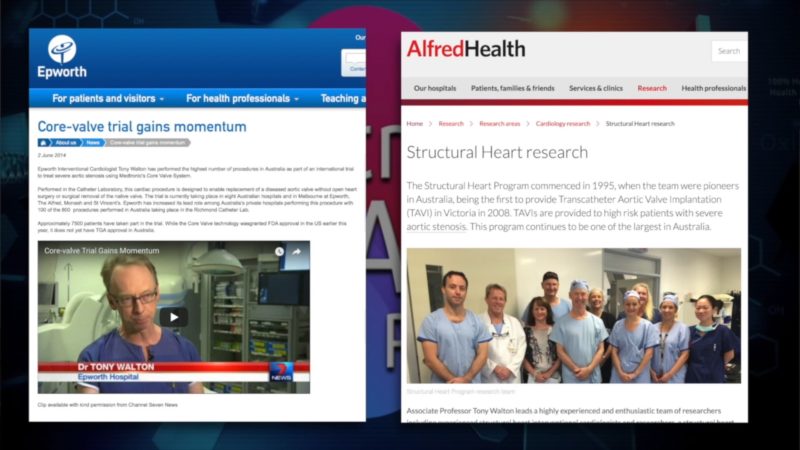
AHJ S1E4: TAVI 10 Year Anniversary
2018 marks the 10 year anniversary of the TAVI device, short for the Transcatheter Aortic Valve Implantation. The TAVI system enables the replacement of a diseased aortic valve without open-heart surgery or surgical removal of the native valve.
This minimally invasive surgical option reduces operating time and allows for a shortened recovery period for patients.
AHJ met with the cardiologist teams in Melbourne’s Epworth and Alfred Hospital who have involved in implanting the device over the past 10 years.
Interviews:
- Associate Professor Tony Walton, Epworth Hospital, Director of Catheter Laboratory and Deputy Director of Cardiology – Alfred Health
- Associate Professor Ron Dick, Director of Cardiac Sciences – Epworth Healthcare
- Professor Stephen Duffy, Alfred Health